Connect:
                    Walker Productions
  • About
  • Publications
    • NOVELS
    • MUSIC BOOKS
  • PLAYTIME
  • Composing
    • Songs for choirs
  • Services
  • Contact
  • Blog

Explaining Death To Children Without Religion - What Comes After

13/8/2025

0 Comments

 
Explaining death to a child is one of the hardest conversations a parent can have.

For generations, many families relied on religious beliefs to offer comfort: a heaven, a next life, or a reunion with loved ones. But today, more parents than ever identify as non-religious, and those explanations may not feel authentic to them.
That doesn’t make the conversation any less important—it just means we need to find language that is both honest and gentle.

Start with what they know. Young children understand the world through patterns and comparisons. You can use nature as a guide:
  • Leaves grow green in spring, turn gold in autumn, then fall and become part of the earth again.
  • Flowers bloom, fade, and return the next year from new seeds.
  • Day turns to night, night to day.
This helps children see that change, endings, and renewal are part of life’s cycle.

One of the simplest non-religious ways to explain death is to compare it to the time before we were born.

You can say: “Before you were born, you weren’t anywhere—you didn’t feel sad or scared, you simply didn’t exist yet. When we die, it’s like going back to that. But while we’re alive, we get to love, play, laugh, and make memories.”

This explanation is honest, age-appropriate, and free from fear. Children find comfort in knowing that the people (and pets) they love live on in their memories. You might say: “When we remember the happy moments we shared with someone, in a way they’re still with us.”

This can also be an opportunity to teach values: the kindness we show in life is what people will remember when we’re gone.

I recently wrote a picture book on the subject, What Comes After, because I realised most modern parents—especially those raising young children today—are not religious. But there were very few picture books about death that explained it in a way that was truthful, gentle, and comforting without relying on an afterlife.

The story follows Little Cub, who spends one last evening with his Grandpapa Bear. Through their conversation, Grandpapa explains life and death by comparing it to nature and to the time before we are born. It’s a warm, tender tale that encourages kindness, memory, and living fully.

My hope is that What Comes After will help parents have one of life’s hardest conversations with honesty and love—and give children the tools to understand and cope with loss.

What Comes After is available now on Amazon as a beautifully illustrated paperback for £5.99.
Order your copy here and give your child a gentle, non-religious introduction to life’s biggest mystery.

Picture
0 Comments

What you can expect from my proofreading services

25/8/2019

1 Comment

 
Picture
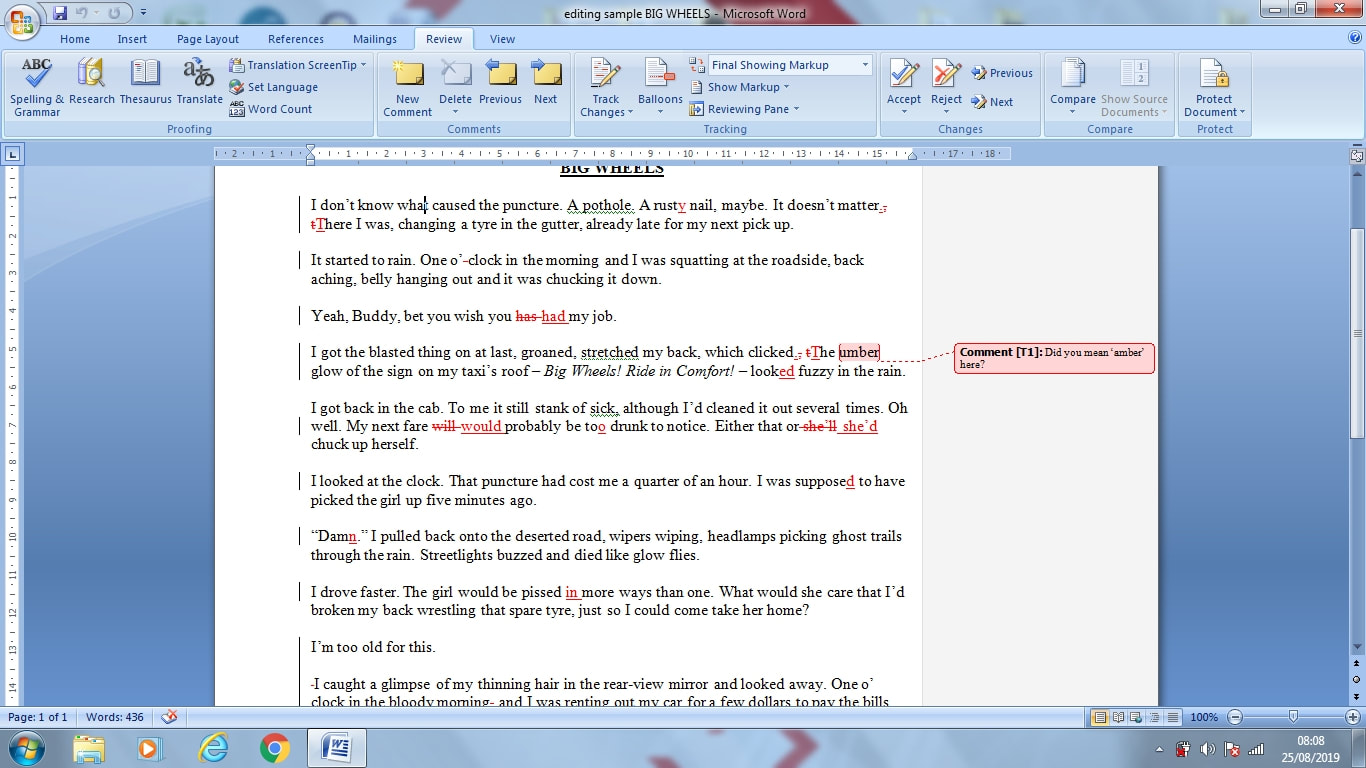
You can see above a screenshot of a sample edit. The tracked changes show up in red, with any comments in the margin.  

editing_sample.pdf
File Size: 115 kb
File Type: pdf
Download File


editing_sample.doc
File Size: 32 kb
File Type: doc
Download File


​You can download the .doc file above and open it in Word or Pages on your Mac. Have a practise! By clicking the Review tab in Word (as in the picture above) you can accept or reject the changes one-by-one, or you can accept all changes to the document with one click. Click on the 'Accept' button, which is just right of centre in the Review tab. To accept all changes, click the arrow just below the word 'Accept' and then click 'Accept all changes in Document'.

Make sure the 'track changes' button (dead centre in the Review tab, see above) is NOT pressed/selected. If it is, everything you type will come up underlined red.

Notice the vertical lines to the left of certain paragraphs. These inform you that changes have been made to those lines of text, just so you don't miss anything.

I charge £4 per 1,000 words for a proofread (minimum charge £4). Your edited document will appear with tracked changes like the picture above. Please contact me if interested!

1 Comment

Why I Offer Proofreads, Not Line Edits

22/8/2019

0 Comments

 
There are lots of freelance editors out there. Proofreaders, copy-editors, line-editors... so much choice! Who should you go with?

Well, what's the difference?

Proofreaders analyse your manuscript for spelling, punctuation, grammar and syntax mistakes.
Copy-editors address all those errors, but also check your facts (very important for non-fiction) and consistency.
Line-editors address all of the above, but also your writing style, voice, and your story as a whole.

The other obvious concern is cost. Proofreaders usually charge between £5-8 per 1,000 words (I charge £4), copy-editors between £8-11 and line-editors from £12+. There are a couple of reasons for this. Line-editing takes longer than copy-editing, which takes longer than proofreading, but they also requires a different set of skills.

So which type of editor is right for you?

If you are thinking of submitting to literary agents (and I would absolutely recommend you do this before considering self-publishing) I do NOT think you need to pay for a line edit.

Why?

Because if you do land an agent they will then line edit your manuscript. And if they manage to sell your book to a publisher, the publishing house will then line edit it again.

Every editor has their preferred style. One editor might like your voice, or a certain character, or a plot twist, whilst another might not. One editor might think your story needs more pace, another might not.

The same with readers. Some readers will like your book. Some will not, no matter what you do to it. If you change it to suit a certain editor, the outcome stays the same: some readers will like your book, and some will not.

Changing any aspect of your story or your style to suit a specific editor is only worth doing if you know it will improve your chances of success.

If the line-editor combing through your manuscript is your agent, and you've done your research and you know they are successful in selling books to publishers, you can be confident they will add value. Also, your agent will do this for free. Your agent will know which publishers they intend to pitch to and will know (should know) what kind of stories and styles they buy.

If you do have the money to pay for a line edit and think that's the way to go, you want to find a line-editor who has a good track record helping authors get picked up by agents. Don't just look for qualifications. Experience is what matters.

Your writing style and your voice need to come from you. They cannot be outsourced. But how do you find your voice?

Write a lot. Write a lot and read a lot. It will come. There is no substitute for practise.

So. You've decided against a line edit. Why would you want a proofread?

It doesn't seem to matter how often you read through your manuscript, writers always seem to miss something. Maybe it's the wood for the trees.

Putting your finished manuscript aside for a few weeks before coming back to it does seem to help. But sometimes you need someone else's fresh eyes. I can catch those grammar slips we all miss from time to time. Point out the odd awkward phrase or that paragraph that doesn't quite make sense.

I won't tell you if I think a character is weak, or the piece needs restructuring, or it needs more pace. Why? Because that's all subjective, and I don't want to force my preferences on your manuscript. Other readers have different preferences.

So I won't tell you to change your story. But I will help you improve your writing. Grammar is not subjective. Agents will reject anything with poor grammar - don't let it spoil your chances! If you think you have a great book but know grammar is not your strong point, drop me an email. I can help.

Cost of my proofreading service is £4 per 1,000 words. I also offer a fiction submission package for £40 (cover letter, synopsis and first 10,000 words). More information here.
0 Comments
    Picture

    Archives

    October 2023
    October 2022
    September 2022
    November 2019
    August 2019
    August 2018
    March 2018
    June 2015
    April 2015
    December 2014
    November 2014
    October 2014
    August 2014
    December 2013
    October 2013
    September 2013
    August 2013

    Categories

    All
    Classical Masterpieces
    Miscellaneous
    Music
    Music Compositions
    Services
    Writing Misc.
    Writing - Misc.
    Writing Resources
    Writing - Resources
    Writing - Short Stories

Powered by Create your own unique website with customizable templates.